
Samsung's bold move
The Samsung Galaxy Z TriFold features a trifolding design with dual hinges that unfolds to a 10-inch main screen and a 6.5-inch cover display. It uses the Snapdragon 8 Elite processor and comes with a large 5600mAh battery with 45W charging. The Galaxy Z TriFold also features an IP48 rating, titanium hinges, and Corning Gorilla Glass Ceramic 2 for durability.
Pros
- Big 10-inch inner foldable display with a 120Hz refresh rate
- IP48 dust and water resistance
- Faster and more powerful Snapdragon 8 Elite chipset
- Inner foldable display always remains protected
- Triple rear cameras, including a 200MP main sensor
Cons
- Cannot be used like a book-style foldable
- Thicker than the Mate XTs even when unfolded
- Heavier at 309 grams
- Only supports up to 45W charging speed

A bolder trifold approach
The Huawei Mate XTs has an outward-folding trifolding design with a 10.2-inch OLED display that supports single, dual, and triple-screen modes. It runs on Huawei's own Kirin 9020 chipset with HarmonyOS and includes a 5600mAh battery offering 66W wired and 50W wireless charging.
Pros
- Offers a larger 10.2-inch display and is slightly lighter
- Premium leather finish option
- Compatible with stylus input
- Can also be used as a book-style foldable phone
- Faster 66W charging speed
Cons
- No Google apps support
- No 5G support (only 4G)
- No dust rating
- Z-style foldable design means the foldable screen always remains exposed
It finally happened. After months of rumors and speculation, Samsung finally took the wraps off its first-ever trifolding smartphone. The Galaxy Z TriFold was unveiled on December 1, 2025, and it offers many benefits and a whole new user experience compared to the standard Galaxy Z Fold lineup we've all come to know.
However, Samsung isn't the first to introduce a trifolding smartphone. Huawei unveiled its Mate XT Ultimate last year, which actually intrigued us quite a bit, and followed it up with a slightly upgraded 's' version, called Huawei Mate XTs, earlier this year.
Both Huawei and Samsung's trifolding phones offer different form factors and designs. But with Huawei already on its second generation of trifolding phones, does its device actually offer more or better features? How different are these two trifolding phones? Let's see how they compare.
Samsung Galaxy Z TriFold vs. Huawei Mate XTs: Pricing and availability

Samsung officially introduced the Galaxy Z TriFold on December 1, 2025. The company didn't showcase the device at an event, but quietly released it through a press release. The Galaxy Z TriFold will be available for purchase in Samsung's home country, South Korea, starting December 12, 2025, for KRW 3,594,000 (~$2,440). The trifolding phone comes in just one color variant called Crafted Black.
Following the launch in Korea, Samsung will bring the Galaxy Z TriFold to other regions, including China, Taiwan, Singapore, the UAE, and the U.S., but the company hasn't confirmed launch dates for these markets just yet.
The Huawei Mate XTs was introduced in early September 2025 in China. Currently, the Mate XTs is available only in China, but the brand may launch it globally at a later stage, similar to what it did with the first-generation Mate XT.
In China, the Mate XTs starts at 17,999 CNY (~$2,550) for the base model with 256GB storage and 16GB RAM. It goes up to 21,999 CNY (~$3,100) for the top model with 1TB storage and 16GB RAM. Unlike the Galaxy Z TriFold, the Mate XTs comes in four colors: Red, Black, Purple, and White.
Samsung Galaxy Z TriFold vs. Huawei Mate XTs: Design and build

The difference in design between traditional slab smartphones and even book-style foldables is limited due to their similar form factor, but when you have two movable hinges and three foldable display parts (hence the name 'trifold'), the result is exactly the difference you get between the Galaxy Z TriFold and the Huawei Mate XTs, with both opting for very different approaches.
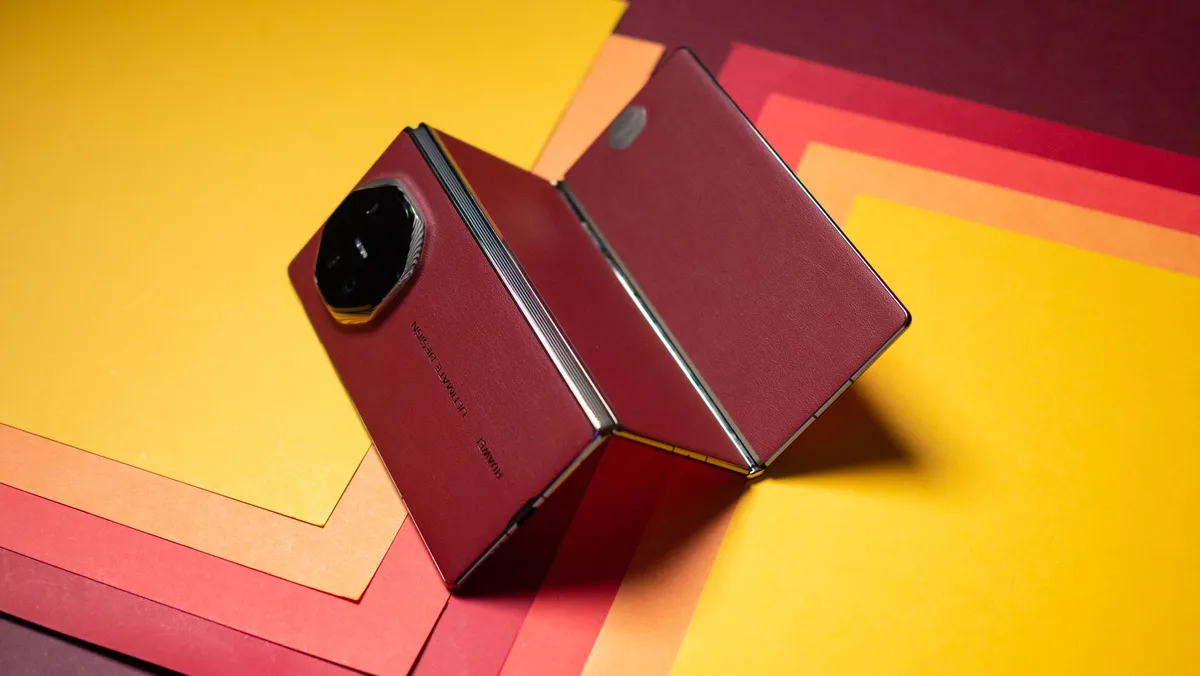
On the Huawei Mate XTs, you get a single large 10.2-inch foldable display that folds twice (almost in a Z shape) to form the cover display, which works and looks like a traditional smartphone, though one edge is made of a plastic foldable panel. The Mate XTs can then unfold twice, first into a book-style foldable similar to the Pixel 10 Pro Fold or the Oppo Find N5, and then fully open into a large 10-inch tablet-like display.
The Samsung Galaxy Z TriFold takes a different approach. Samsung says that in order to protect the inner foldable display, since it's quite sensitive, it designed the hinge system differently.
Think of the Galaxy Z TriFold as a U-shaped foldable with two vertical sides folding inward. The cover display is a completely separate outer screen that measures 6.5 inches and is actually the same panel used on the Galaxy Z Fold 7's cover display. This cover display boasts up to 2,600 nits of peak brightness and supports up to a 120Hz refresh rate.

In terms of build, Samsung seems to take the lead since it uses advanced and premium materials such as Corning Glass Ceramic 2 for the outer cover display, while the rest of the phone is protected by ceramic glass fiber reinforced polymer and an Advanced Armor Aluminum frame for maximum durability.
The company has also used two titanium hinges for extra strength to protect the foldable from drops and jerks. Moreover, despite being Samsung's first trifolding phone, the company has paid close attention to durability, with the device offering IP48 dust- and water-resistance.
Using the same folding display as the cover display keeps the Mate XTs from having a larger profile. The Mate XTs is thinner than the Galaxy Z TriFold when unfolded, with a 3.6mm vs 3.9mm profile, and in general, the Mate XTs has a slightly smaller footprint than the Galaxy Z TriFold.
Coming to the specs of the foldable displays used on both phones, Samsung again takes the lead. The Galaxy Z TriFold's inner foldable display is a large 10-inch LTPO AMOLED 2X panel with a 1584 x 2160 resolution, a 120Hz refresh rate, and 1,600 nits of peak brightness.

The Mate XTs has a slightly bigger 10.2-inch LTPO OLED panel, and even though it offers a higher 2232 x 3184 resolution, it comes with only a 90Hz refresh rate, which is uncommon for most flagship Android phones, let alone a smartphone that costs over $2000.
Both Samsung and Huawei include a slim kickstand case in the box with their trifolding phones to help the device stand up for watching content or productivity, but the case also acts as hinge protection (or, in Huawei's case, a protector for the exposed part of the screen), making it almost necessary to use.
Samsung Galaxy Z TriFold vs. Huawei Mate XTs: Hardware and specs

Qualcomm recently introduced the new Snapdragon 8 Elite Gen 5 processor, and while Samsung foldables usually pack the latest Snapdragon chips, the Galaxy Z TriFold actually uses the previous-generation Snapdragon 8 Elite.
However, that shouldn't be an issue for anyone looking to buy this trifolding phone since the Snapdragon 8 Elite is still a very capable chipset and offers more performance and raw power than you'd realistically need from a foldable.
Huawei's Mate XTs, similar to other smartphones from the brand, uses the company's own Kirin 9020 chipset. For those unaware, this is an octa-core chip with one core clocked at 2.4GHz, three at 2.00GHz, and four at 1.6GHz. This chipset, however, won't match the performance that the Snapdragon 8 Elite delivers on the Galaxy Z TriFold.

In terms of other internal hardware, the Galaxy Z TriFold comes with a minimum of 512GB of onboard storage and goes up to 1TB. The Huawei Mate XTs starts at 256GB and also offers 512GB and 1TB variants. Both phones offer 16GB RAM across all models.
For battery life, both phones pack large 5,600mAh batteries. And even though Samsung gives the Galaxy Z TriFold the same 45W charging speed as the Galaxy S25 Ultra, it's still outshone by the Mate XTs, which offers 66W fast wired charging.
Both phones support wireless charging as well, with the Galaxy Z TriFold offering 15W wireless input, while Huawei takes the lead again with support for up to 50W wireless charging.
Both devices also include a side-mounted fingerprint sensor for unlocking, with no in-display sensor support on any of the devices. However, it's worth noting that the Huawei foldable, similar to most Huawei smartphones, doesn't offer 5G compatibility in most global regions.
Category |
Samsung Galaxy Z TriFold |
Huawei Mate XTs |
|---|---|---|
OS |
One UI 8 (Android 16) |
HarmonyOS |
Display |
Cover display: 6.5-inch, FHD+, Dynamic AMOLED 2X, 2600 nits peak brightness, 120Hz, Gorilla Glass Ceramic 2 Main display: 10-inch, Dynamic LTPO AMOLED 2X, 120Hz, 1600 nits peak brightness |
Main display: 10.2-inch, LTPO OLED, 90Hz, 2232 x 3184 pixels Cover display (1/3rd of the main screen): 6.4-inch, LTPO OLED, 90Hz |
Stylus support |
No |
Yes |
Processor |
Qualcomm Snapdragon 8 Elite |
Kirin 9020 |
RAM |
16GB |
16GB |
Storage |
512GB / 1TB |
256GB / 512GB / 1TB |
Rear cameras |
200MP main + 10MP telephoto (3x) + 12MP ultra-wide |
50MP main + 40MP ultra-wide + 12MP periscope telephoto (5.5x) |
Front camera |
10MP |
8MP |
Ingress protection |
IP48 |
— |
Connectivity |
Global 5G, Wi-Fi 7, Bluetooth 5.4, NFC |
4G only, Wi-Fi 7, Bluetooth 5.2, NFC |
Security |
Fingerprint sensor (side-mounted), Face unlock |
Fingerprint sensor (side-mounted), Face unlock |
Battery |
5,600 mAh |
5,600mAh |
Charging |
45W USB-C fast wired charging |
66W USB-C fast wired charging 50W wireless charging |
Dimensions |
Folded: 159.2 x 75 x 12.9 mm Unfolded: 159.2 x 214.1 x 3.9 mm Weight: 309g |
Folded: 156.7 x 73.5 x 12.8 mm Unfolded: 156.7 x 219 x 3.6 mm Weight: 298g |
Colors |
Crafted Black |
Red, Black, Purple, White |
Finally, one advantage the Huawei Mate XTs has over the Galaxy Z TriFold is support for stylus input. Samsung has confirmed that the Galaxy Z TriFold doesn't support S Pen input, but Huawei sells a separate stylus for the Mate XTs that takes the productivity of the device to another level.
Speaking of productivity, let's take a look at the software you get on both devices. The Galaxy Z TriFold, as expected, runs on One UI 8 out of the box based on Android 16, complete with new trifolding-focused features like a standalone DeX mode that turns the foldable into a full computing device for complex tasks.
In DeX mode on the Galaxy Z TriFold, apps open in windows like on a laptop, and you can also create multiple desktops to keep different windows organized. Samsung also allows you to run three different apps side by side on the Galaxy Z TriFold.
On the other hand, the Huawei Mate XTs, since it's a China-only device for now, runs on the company's HarmonyOS 5.1. The foldable comes with many productivity features, including stylus support for workspace apps like Docs, OfficeSuite, and Notes. However, as with other Huawei smartphones, it doesn't support Google Play services out of the box.
This means you can't install apps from the Play Store like you would on the Galaxy Z TriFold and instead have to rely on Huawei's AppGallery for third-party apps.
Samsung Galaxy Z TriFold vs. Huawei Mate XTs: Cameras

The closest these two foldable phones probably get is in terms of the camera. Both the Huawei Mate XTs and the Galaxy Z TriFold come with a triple-camera system. In fact, the setup on the Galaxy Z TriFold is exactly the same as the one on the Galaxy Z Fold 7.
This means you get a 200MP primary camera with PDAF and OIS, paired with a 10MP telephoto sensor offering up to 3x optical zoom and a 12MP ultrawide sensor with a 120-degree FoV.
On the Huawei Mate XTs, you get a lower-resolution 50MP primary sensor, but the telephoto camera is a better 12MP unit with up to 5.5x optical zoom clarity. Similarly, the ultrawide sensor on the Mate XTs appears stronger thanks to a 40MP sensor.
We haven't tested the cameras on both devices yet, but given that the Galaxy Z TriFold uses the same sensors and chipset as the Z Fold 7, we expect similar performance. We also haven't gone hands-on with the Mate XTs, but once we do, we'll share a more detailed look at their camera performance.
Samsung Galaxy Z TriFold vs. Huawei Mate XTs: Which should you buy?
When it comes to choosing between the Galaxy Z TriFold and the Huawei Mate XTs, it's not as simple as picking between two Android flagships. The real challenge isn't just the difference in specs or features, but sheer availability.
Both phones use extremely new form factors and are very expensive to manufacture, making them difficult to find. The Galaxy Z TriFold is currently launching only in Korea, and even after that, it'll open for sales only in the UAE, China, Taiwan, Singapore, and next year in the U.S.
Similarly, we don't yet know when the Huawei Mate XTs will be available globally. If Huawei follows the Mate XT's rollout, it'll likely launch in Q1 2026. That said, even if Huawei does bring it to global markets, it won't come to the U.S, and the lack of 5G connectivity and no Google Play services will remain major downsides, likely making the Galaxy Z TriFold a better purchase if both are available in your region.
It's worth noting that we haven't used either device yet, so the final verdict is still out.
First trifolding phone coming to the U.S.
The Samsung Galaxy Z TriFold isn't available in global markets just yet, but the company has confirmed it'll launch in early 2026. When the phone does arrive, it'll bring a new user experience and a form factor unlike anything consumers have used before.
Big, bold, and stylish
Huawei hasn't announced a global launch for its Mate XTs, but the trifolding phone does come with some impressive features, like a huge 10.2-inch display with the benefit of working as a traditional smartphone, a book-style foldable, and even a tablet. It features a premium material build and some impressive camera hardware that's uncommon in foldable phones.

