NFC

What is NFC?  NFC stands for Near-Field Communication and is a set of standards (established in 2004) for small, portable devices to establish radio communications with each other. Devices need to be close, usually no more than a few centimeters apart (and often they need to touch), which is why it's a Near-Field way to communicate. The standards cover data exchange formats defined by the NFC Forum (no, not that kind of forum) and are based on the original radio frequency identification (RFID) standards.  The forum also certifies devices like tags, cards, and smartphones.  

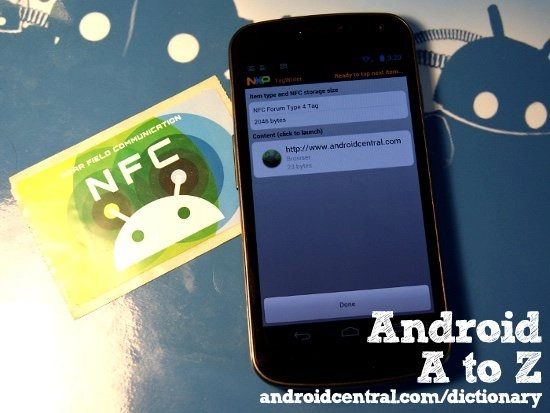
The coolest part of all this is that only one of the devices needs to be "smart."  Most of us has a credit card of some sort that we can tap against a payment machine, either at the gas pump or a cash register.  Both the payment machine and the credit card are NFC devices, but the card only has a string of information electronically written to a tiny chip embedded inside it.  And this is useful for other things, like starting and handling more robust communications like Wifi or Bluetooth, but most often it's used with one of these "dumb" chips.  These dumb chips can be written with any information, and the smart device determines what happens when communication is established.  

Of course, what most of us here think of when we hear NFC is Google Wallet.  Google Wallet takes things a step further by using your Android phone as both a smart device and a dumb device.  When you tap your phone at McDonald's to pay for those McNuggets, it's simply sharing your credit card credentials like any card would.  But there's functionality and hardware there to accept payments, track balances, provide security and more.  Right now it's only officially available as a test on the Nexus S 4G, but it's been hacked onto other phones with NFC hardware.  Soon, we'll see it (and other apps for things like ISIS) as a standard on Android phones.  Until then, we'll just have to play with tags and Android Beam.

Previously on Android A to Z: What is MWC?; Find more in the Android Dictionary

More from the Android Dictionary

Android A to Z - MWC
Article
by Phil Nickinson
Jan 25, 2012
What is Mobile World Congress? The next big mobile trade show on our Android schedule is Mobile World Congress -- or MWC, for those in the know. It's in Barcelona, Spain, and has been since 2006...
Android A to Z - What is a launcher?
Article
by Phil Nickinson
Jan 24, 2012
What is an Android launcher? Probably the most powerful feature of Android is its ability to be customized. And that starts with what's typically called the "launcher." The launcher us...
Android A to Z
Article
by Jerry Hildenbrand
Jan 23, 2012
What is a kernel?  If you spend any time reading Android forums, blogs, how-to posts or online discussion you'll soon hear people talking about the kernel.  A kernel isn't somethin...
JIT
Article
by Jerry Hildenbrand
Jan 20, 2012
What is the JIT?  JIT stands for "Just In Time," and we use it to describe a Dalvik JIT compiler, which was added to Android with the 2.2 release.  It compiles bytecode into nati...
Android A to Z - What is IPS?
Article
by Phil Nickinson
Jan 19, 2012
What is an IPS display? IPS stands for In-Plane Switching. It's commonly found in high-end monitors -- gaining mainstream notoriety in Apple's displays -- and has also found its way into tab...

 
There are 3 comments

McPlot says:

So, it has nothing to do with football?

nathaniz says:

I'm not well educated on this stuff, so if my question is elementary, please be kind.
If the dumb chips in our credit cards can be read with a tap or bump or within a "short" or "near-field" distance, what's to keep some rogue element from hacking a piece of hardware to read the chips and steal my info by say, swinging it past my back pocket where my card sits in a wallet or past my hand while I'm holding my card waiting in a check-out line or bumping into me or something? Is there some security code known only to the dumb chip that opens it to be read? If so, how do the various smart devices I've never used before know the code to my card?
I have to believe security has been built in somehow?

They all use a secure token of some sort.  It's all proprietary, so we don't really know how they're doing it, but things like my Shell card only work on special gas pumps that can communicate.  If I hit it with my phone, it's just gibberish on the embedded tag and it can't do anything with it.