
Modern displays are truly amazing. The paper-thin, flexible OLEDs in the latest TVs and smartphones are not only amazingly thin but also sport unparalleled color accuracy, astounding contrast, buttery-smooth refresh rates, and brightness like no one could have imagined until now. But among all these specs, something keeps getting forgotten: our eye health.

Android Central Labs is a weekly column devoted to deep dives, experiments, and a focused look into the tech you use. It covers phones, tablets, and everything in between.
Staring at blindingly bright screens for hours a day is, unsurprisingly, causing massive discomfort for an ever-growing percentage of the populace. Experts once thought that a blanket "screen time" metric could help reduce the pain, but it turns out that there's a lot more to what makes displays painful to look at. Thankfully, a few companies are actively working to fix those problems.
Chief among them is BOE Technology Group, whose displays power many of the world's most popular phones, and has been the world's leading display manufacturer since 2023. I write tons of display reviews every year for Android Central, and BOE's displays are always the most eye-friendly displays from any major brand.
The company took its most recent innovations to SID Display Week in Los Angeles, and I couldn't help but be impressed by its ever-growing focus on making displays that not only look good but also feel good to look at. BOE broke it down into four categories that I'll analyze today: spectrum optimization, depolarization, anti-glare, and flicker.
What's in a spectrum?

The light spectrum isn't something we think much about in our daily lives, unless we're shopping for light bulbs or toying around with night mode display features on our phones. Our eyes were built to absorb the full spectrum of light from natural sources, but, unsurprisingly, the artificial light from most displays is anything but natural-looking.
Most OLEDs and LCDs follow a similar pattern. Since they use red, blue, and green subpixels, a graph of the light spectrum emitted by these displays shows steep peaks in each of these three colors, while the rest of the spectrum is left out.
It's usually possible to go into display settings and tweak the color output a bit (usually described as a warmer or cooler temperature), but this doesn't spread the colors across the spectrum; it just alters the height of the red, green, and blue peaks.

Looking at the graph above, you can see that the natural light graph (which represents sunlight filtered through cloud cover) shows a fairly even distribution across all colors in the spectrum. Some colors are slightly more intense than others, but none are "missing" from the graph.
Meanwhile, most LCD and OLED displays have pronounced valleys and steep peaks, which inherently cause some degree of eye strain due to the missing colors. Some LED bulbs and LED backlights on e-readers can produce quite a bit more color than LCD or OLED, but you'll often find parts of the spectrum missing entirely in the outermost sections.
BOE's next-generation display technology uses what it calls Beneficial Natural Light (BNL) to fill that color spectrum far more than existing technologies, and it does so across several different display types, too. On the show floor, BOE presented this across LCD, OLED, and micro-OLED displays, adopting the best features of each technology while leveraging the advantages of a more natural color spectrum.
Flicker, the headache machine

For several years now, I've written about how display flickering is causing debilitating pain in an increasing percentage of the population. While some companies refuse to provide solutions for customers facing these problems, BOE has done a superb job of introducing new displays with lower flicker rates since then.
At the show, BOE focused on three solutions that help solve the flicker problem: DC dimming, 4320Hz PWM dimming, and ultra-high refresh rates. Phones like the Honor Magic 8 Pro use BOE Displays with DC dimming at medium to high brightness, then switch to 3840Hz or 4320Hz PWM dimming at low brightness to strike an excellent balance between image quality and eye care.
BOE is taking that one step further by creating new displays that operate at 1000Hz refresh rates at full 1080p resolution (pictured above). This particular display uses Oxide TFTs with a 1ms response time to create the smoothest experience you've ever seen. This was only shown off on a 24.5-inch monitor, but I'm hoping to see this kind of tech make its way to mobile devices.
Kill the glare

Boe is a bit behind on this one, as companies like TCL and Samsung have been utilizing anti-glare layers on their phones for a few years. TCL's next-generation NXTPAPER display is launching later in 2026 and will be the world's first OLED display with an anti-reflective layer. Samsung has been using an anti-glare layer on its flagship Ultra series since 2024 (pictured above), but it cuts glare rather than preventing reflections entirely.
The first BOE OLED I used with an anti-glare layer is on the Honor Magic V6, a phone that launched in June and sports an anti-glare layer similar to that of the Galaxy S Ultra series. The tech BOE showed off at the SID show looked identical to this, so while I'm not expecting anything new from the company compared to what's on the Magic V6, it likely means we'll start seeing more phones with this important feature.
Anti-glare is about more than just cutting annoying reflections. It also enhances colors and black levels, helps prevent eye strain, and keeps your phone from emitting peak brightness as often (since it doesn't have to fight against reflective light).
Depolarized light

Circular polarizers have become more commonplace in modern mobile displays because they help prevent the annoying blackout that occurs when viewing linearly polarized content through polarized sunglasses. In other words, you can use your phone in portrait and landscape while wearing polarized glasses, so long as it uses a circular polarizer. Plus, circularly polarized displays are brighter than linearly polarized ones in the same situation.
Surprisingly, circular polarizers are good for more than just outdoor or in-car phone visibility. They also help scatter light in a way that's more natural and less direct than an LCD or OLED might otherwise be, helping lutein levels to remain higher than with linearly polarized displays.
Studies show that higher lutein levels improve eye performance, so your display (and everything else) continues to look good with prolonged use, while contrast and clarity can diminish over time as lutein levels decline.
Just the tip of the iceberg
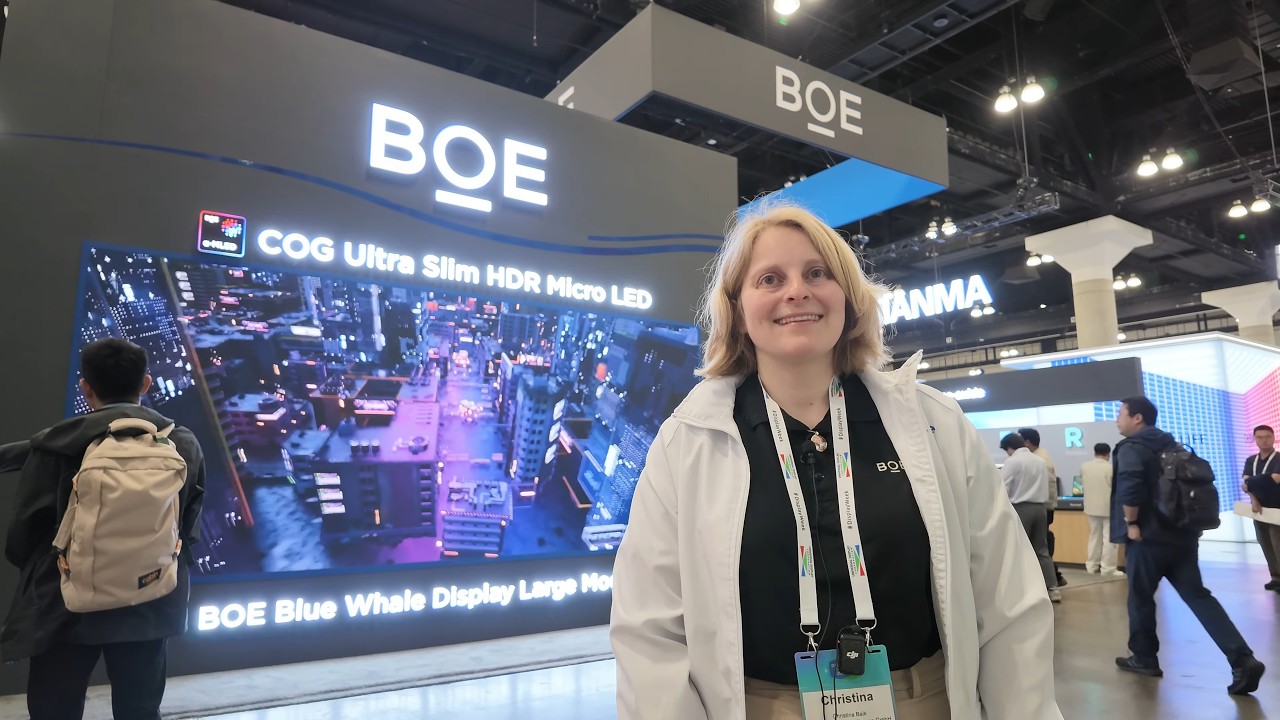
If you want to see more of what BOE is working on, the display tour video above is the most comprehensive I could find from SID Display Week 2026. It goes over a ton of additional products and concepts the company is working on — like a true creaseless foldable display, transparent OLEDs, ultra-wide-gamut TVs, etc — but it's telling that BOE has such a large section devoted to eye health.
To my knowledge, only TCL shows such strong commitment to eye health with its NXTPAPER products (and beyond), while companies like Samsung never even mention eye health when announcing new products. I often get completely ignored by Samsung when I ask questions about color spectrum output, display flicker improvements, and similar topics, and my eyes (and the feedback from many people online) tell me that eye health simply isn't a concern for the company.
As we add more and more displays to our lives — whether that's the phone in our hand or the multitude of signs and advertisements in public spaces — eye health is becoming an increasingly important topic for display companies to focus on, and I'm glad to see that significant work is being put into ensuring the long-term health of the people who look at them.

