
Mobile gaming is a point where mid-range and even a few budget phones can play demanding games at stable framerates without too much of a hassle. That's a good thing in countries like India, where a mobile phone is often the only screen available. So any headway that can be made to make gaming better — or just about any other use case on mobile — has tangible gains.

In Hardwired, AC Senior Editor Harish Jonnalagadda delves into all things hardware, including phones, audio products, storage servers, and networking gear.
That's why I was excited to talk to Arm's senior director of smartphone segment strategy, Steve Raphael, to know about the brand's plans relating to mobile gaming and AI innovations. Raphael talked about Arm's mission to bring "console-quality" gaming to mobile, and that it has an "amazing roadmap" of announcements in this area.
Raphael talked about technologies that have made a real difference in the world of Windows gaming — DLSS or FSR — and bringing something similar to mobile devices. Arm introduced Accuracy Super Resolution (ASR) nine months ago, but it started demoing the tech in action at MWC 2025, and is slated to serve up additional details at GDC 2025 in a few weeks' time.
Similar to NVIDIA's DLSS, ASR uses temporal upscaling to deliver significantly better visual fidelity. Essentially, the tech renders a scene at a lower resolution, and uses AI models to upscale to a higher resolution, leading to smoother framerates and better clarity. Arm showcased a demo running on a device powered by the Immortalis-G925 that was connected to a tablet, and while there was some artifacting, it was smooth, and the overall visual quality was terrific.
The tech can deliver gains of up to 53%, and I see it making a difference in budget and mid-range chipsets, where there's a need for this kind of a feature. Arm isn't starting from scratch, instead leveraging AMD's open-source FSR2 upscaler as the foundation — this is absolutely the right move, as it allows Arm a decent head-start.
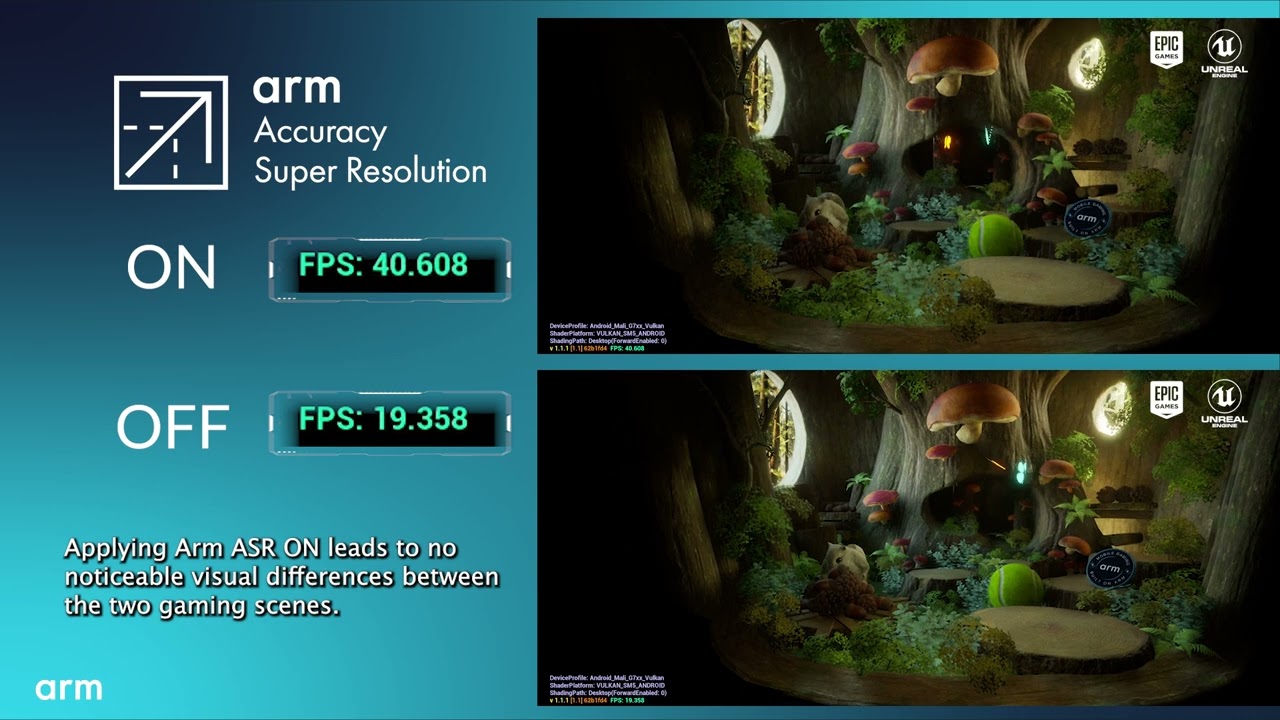
Upscaling makes sense on mobile as there's a limited power budget on the device, and any shortcut you can take to increase framerates without overheating or needlessly throttling is a huge bonus. And as this is being baked in at the platform level, all devices that are powered by Arm hardware — basically every Android phone — stand to benefit.
I shifted gears to talking about AI and mobile NPUs, and Raphael stated that Arm did a "tremendous amount of work" this year to make it easy to load AI applications into the CPU, integrating numerous libraries and optimizing usability so they're effortless to get started.
On that note, Arm teamed up with Stability AI to bring generative audio to phones, and it showcased the tech in action at MWC 2025. The brand is going to debut image, video, and 3D generation tools on its devices in the coming months. Most AI use cases on mobile are cloud-driven, but it isn't sustainable to send swathes of data to a cloud server to get the requisite information; Raphael talked about this "asymmetry" where considerable energy is used to send data to a cloud server, and how it ends up being a "huge burden."
Balancing efficiency with performance is going to be pivotal with these AI workloads, and Raphael mentioned how the brand made "phenomenal amounts of efficiency gains" in the last two years, and that Arm is looking to deliver more AI use cases on-device instead of information going to the cloud.

I also asked about the recent trend with mobile platforms where manufacturers like MediaTek and Qualcomm are leveraging big cores exclusively in their products instead of the heterogenous configurations we've seen in years past. Raphael said that it is driven by a need for Arm's partners to deliver the best possible performance, and that although designs like the Dimensity 9400 exclusively use Cortex X925, X725, and A720, the inherent gains with the latest v9 core means they deliver much better efficiency than their predecessors.
Raphael also mentioned a key point about the frequencies at play, noting that although cores now go up to over 4GHz, the time that they're actually running at that frequency is minuscule, often measured in milliseconds. The idea is to execute a task as fast as possible — such as an app launch — and go back to idle state to maximize efficiency, and this is what makes devices like the Vivo X200 Pro last at least a day and a half even though it is made up entirely of powerful cores.
Lastly, I talked about Arm's licensing model and whether we'll see any changes on that front. Raphael stated emphatically that Arm's current model is its "bread and butter," and as it stands to benefit by sharing in a brand's success via royalties, it doesn't see the need to alter the status quo. I asked about the situation with Qualcomm and whether that was resolved, but predictably, I didn't get a comment either way.
Having used NVIDIA's DLSS extensively in the last four years, I'm excited to see how Arm can leverage ASR on mobile devices. The demos it showcased are promising, and the fact that this is agnostic of device maker or chip vendor means all Android devices can take advantage of the tech, and that's a great thing.

